
In short
- A sales funnel is a model of the customer journey, not a tool; five stages are enough for a small service business.
- The stages are reach, interest, enquiry, sale and return; the last one is the one most often skipped.
- Set up measurement at each stage first (GA4, UTM, an enquiry spreadsheet), then fix the narrowest spot.
- Change one thing at a time so you know what worked.
Table of contents (11)
- What is a sales funnel, and what is it not?
- How many stages should a service business funnel have?
- What does a funnel look like for a service business?
- How do I find the stage where I lose customers?
- How do I tag sources to know where an enquiry came from?
- Where do customers usually leak out?
- How can ads and email support the funnel?
- How do I work out what one enquiry and one customer cost me?
- Checklist for building a funnel in a small business
- Summary
- Frequently asked questions
A sales funnel is a simple description of the path a person takes from first hearing about your business to buying from you. For a small local service business, five stages are enough: reach, interest, enquiry, sale and return. People drop out at each stage, so your job is to find where you lose the most and fix that place first.
What is a sales funnel, and what is it not?
A funnel is a model, not software you install. The name comes from the shape: many people at the top who have heard of you, few at the bottom who bought. You do not need expensive tools or complex automation. You need a sheet of paper and a decision about what each stage means in your business.
A funnel is not a guarantee of sales, it will not replace a good offer, and it looks different in every trade. A mechanic may have a two-day funnel, while a renovation can take months. So start by describing your own customer journey instead of copying someone else's diagram.
How many stages should a service business funnel have?
For a local service business I recommend five stages. More usually just makes measuring harder.
- Reach. Someone learns you exist: your Google listing, an ad, a post, a recommendation.
- Interest. They visit your website, read about the service, look at your work and reviews.
- Enquiry. They call, write, fill in a form or ask for a quote. Now they are a contact you know.
- Sale. They get an offer, you agree details, they pay.
- Return. They come back, recommend you, leave a review.
Stage five is the one most often skipped, and in local services it is often the cheapest. A customer who already trusts you costs less than a new one.
What does a funnel look like for a service business?
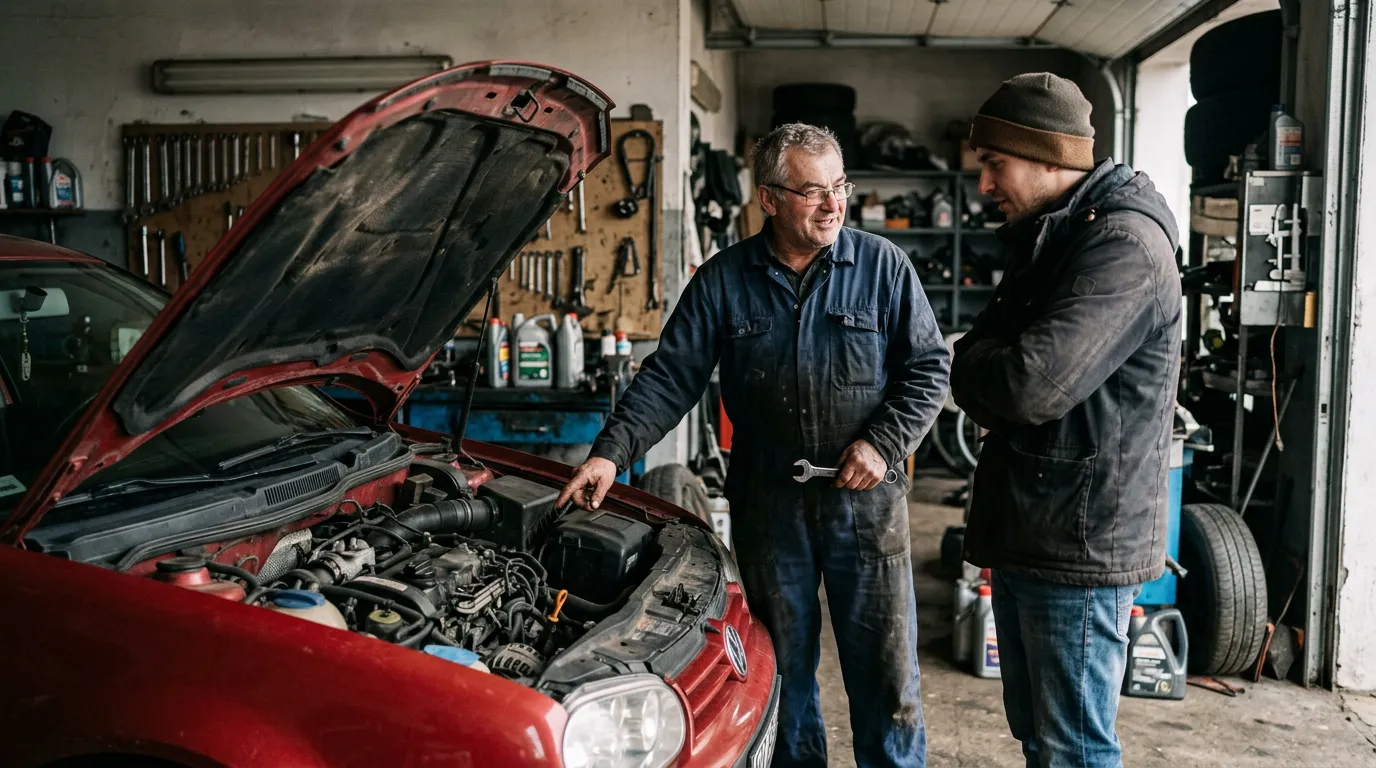
Take an invented renovation company as an illustration. It is only a pattern, with no real numbers.
- Reach: Google listing, a local ad, referrals.
- Interest: a site with service descriptions, a few projects and reviews.
- Enquiry: a form, a phone call, a message.
- Sale: quote, site visit, contract.
- Return: a review request after the job, a reminder before the season, a recommendation to a neighbour.
At each stage ask one question: how do I know how many people made it to the next step? If you cannot answer, you have no measurement there yet. Most of the work on a funnel is setting up measurement first, improving second.
How do I find the stage where I lose customers?
Count four numbers from the last 30 to 90 days: website visitors, enquiries, enquiries that led to a quote, and quotes accepted. The ratio of each number to the previous one shows where the funnel is narrowest.
Two free places to measure it:
- Google Analytics 4. The funnel exploration report shows the steps you define (up to 10), the users at each step and how many abandoned the path. It can be open (users can enter at any step) or closed (only from the first step) (Google documentation). Important actions such as a form submission or a click on your phone number are marked as key events (Google documentation). If you are just starting, read first how to see where your customers come from.
- Your own notes or a simple spreadsheet. When a customer calls, write down how they heard about you. For a small business this is often more accurate than any tool, because calls and word of mouth do not always leave a trace in analytics.
From practice: The most common mistake I see is measuring only website visits. The business is pleased that traffic grows but does not know how many of those people call. Without the number of enquiries you cannot tell whether ads, SEO or anything else works.
How do I tag sources to know where an enquiry came from?
It depends on whether the links you publish are tagged. Google describes UTM parameters for this: utm_source (where from, e.g. newsletter), utm_medium (the channel, e.g. email or cpc) and utm_campaign (the campaign name). After a click on a tagged link, the data appears in the traffic acquisition report in Analytics. Google recommends one standard of tagging across all activities so the data does not split into many rows (Google documentation).
In practice: tag every link in a newsletter, post and ad by the same rule. If you run ads, combine this with conversion tracking in Google Ads.

Where do customers usually leak out?
The narrow spot usually looks like one of these:
- Many visits, few enquiries. The site does not say clearly what you offer, for whom and what happens next. A concrete headline, a visible phone number, a short form and reviews help. More in the post about a website that collects enquiries.
- Many enquiries, few quotes. You reply late or the customer does not know how to order. Set a reply time and a short message template.
- Many quotes, few sales. Usually price, trust or no clear next step. Call two people who did not buy and ask why.
- Little reach. Then you are not fixing the funnel, you are adding people at the top: a Google listing, reviews, ads. Start with the Google Business Profile and reviews.
Fix one place at a time. If you change five things at once, you will not know which one worked.
How can ads and email support the funnel?
Ads add people at the top, but what happens next depends on the rest of the funnel. If you advertise a service and send people to a page that does not collect enquiries, you pay for clicks that never become contacts. For form campaigns see a Meta campaign with a contact form.
For the return stage a simple newsletter for a service business or a reminder text works well. It is not about mass mailing, but about contact when the customer may really need you. How to fit this into a wider plan is part of my online marketing strategy work and of the post on a marketing strategy for a small business.
How do I work out what one enquiry and one customer cost me?
Once you have the numbers from each stage, you can calculate two things. The cost per enquiry is the promotion spend in a given month divided by the number of enquiries. The cost per customer is the same spend divided by the number of people who bought. Include ads, tools and your own time if you want an honest picture.
These two numbers say more than the count of website visits. They show whether an extra pound in ads makes sense, or whether it is better to fix the site first or reply to enquiries faster. Do not compare them with averages from the internet: renovations, medical services and car repair will differ completely. Compare yourself with your own results from previous months.
Checklist for building a funnel in a small business
- Describe your own customer journey in five stages, in your own words.
- Decide which action on the site counts as an enquiry (form, phone, email) and mark it in GA4 as a key event.
- Tag links with UTM parameters by one rule.
- Log every enquiry in a spreadsheet: date, source, outcome (quote, sale, none).
- Once a month count the transitions between stages and find the narrowest spot.
- Fix one thing, wait a few weeks, compare.
- Add a return stage: a review request and contact after some time.
For choosing metrics see the post on marketing KPIs, and a customer persona helps describe who you are talking to.
From practice: Small business owners often want to start with funnel automation tools. I usually advise the opposite: a manual enquiry spreadsheet for a month first, then decide what to automate. A tool makes work easier but does not replace knowing where customers drop out.
Summary
A sales funnel in a small business is five stages: reach, interest, enquiry, sale, return. You do not need an expensive system. You need numbers from each stage, one fix at a time and a regular check on whether enquiries grow. If you like, we can look together at where the funnel is narrowest in your business.
Frequently asked questions
What is a sales funnel?
It describes the customer's path from first contact with the business to purchase, split into stages where some people drop out.
How many stages should a service business funnel have?
For a local service business five are enough: reach, interest, enquiry, sale and return. More usually makes measuring harder.
How do I find where I lose customers?
Count visits, enquiries, quotes and sales over the last 30 to 90 days. The ratio of each to the previous one shows the narrowest spot. The funnel exploration report in GA4 helps.
Do I need special software for a funnel?
Not at the start. GA4, tagged UTM links and an enquiry spreadsheet are enough. Add automation once you know what to automate.
Does a funnel guarantee sales?
No. It is a way to see where you lose customers. It does not replace a good offer or fast replies to enquiries.
Sources
Author
Piotr Babczyński
I help businesses win customers online: SEO, Google and Meta ads, automation and AI. I work from Szczecin, Poland, and remotely. I write about what I test on real projects.
- 30 years in IT
- SEO and Google Ads
- AI implementation
- #marketing
- #sales funnel
- #analytics