
In short
- Google states that AI Overviews and AI Mode have no separate requirements beyond standard SEO.
- The page must be indexed, accessible to the crawler and have its important content in the form of text.
- Write the answer at the start of a section, with concrete definitions, lists and tables.
- Structured data is not required, but it must match the content visible on the page.
- Mass-produced AI texts with no value may break Google's spam policies.
Table of contents (9)
- What AI answers in Google are and where they take their sources from
- What Google says officially about SEO and AI Overviews
- How to write so that content is easy to cite
- Author, experience and credibility
- Structured data and other signals outside the text
- What not to do: mass-produced texts with no value
- How to measure presence in AI answers
- Where to start in your business
- Frequently asked questions
SEO and AI Overviews is the question I hear from business owners more and more often today: do you have to do anything different for Google to show my website in AI answers? Google describes these features as AI Overviews (in the Polish documentation "Przeglądy od AI") and AI Mode. The short answer: there is no separate technique, but there are a few writing habits that increase the chance that someone will cite your business.
What AI answers in Google are and where they take their sources from
An AI Overview is a short summary above the ordinary results, with links to the pages the knowledge comes from. AI Mode is for longer, more complex questions, for which you would previously have had to type several queries.
Both features use the same index of pages as ordinary search. If your page is not indexed or cannot show a snippet, there is nothing to cite. The availability of these features and their scope differ by country and language and change over time, so check how they look for you by typing into Google the questions your customers ask. I do not assume that every customer sees them in the same way.
What Google says officially about SEO and AI Overviews
In its documentation for website owners Google states plainly that there are no additional requirements to appear in AI Overviews and AI Mode, and no special optimisations. The same rules apply as always.
What follows from this in practice:
- the page must be indexed and eligible to be shown in results with a text snippet,
- Googlebot must have access to the page (the robots.txt file must not block it),
- important content should be in the form of text, and not only in an image or in a PDF file with no description,
- you do not need to add any special files or markers "for AI",
- and there is no special structured-data schema that "switches on" citation.
If someone sells you "AI optimisation" as a separate, secret service, ask them to point to the documentation it is based on. Quite a few such offers are simply good SEO under a new name. For the same reason I do not start by changing everything, but by checking the basics. If you do not have them, start with SEO for your website.
How to write so that content is easy to cite
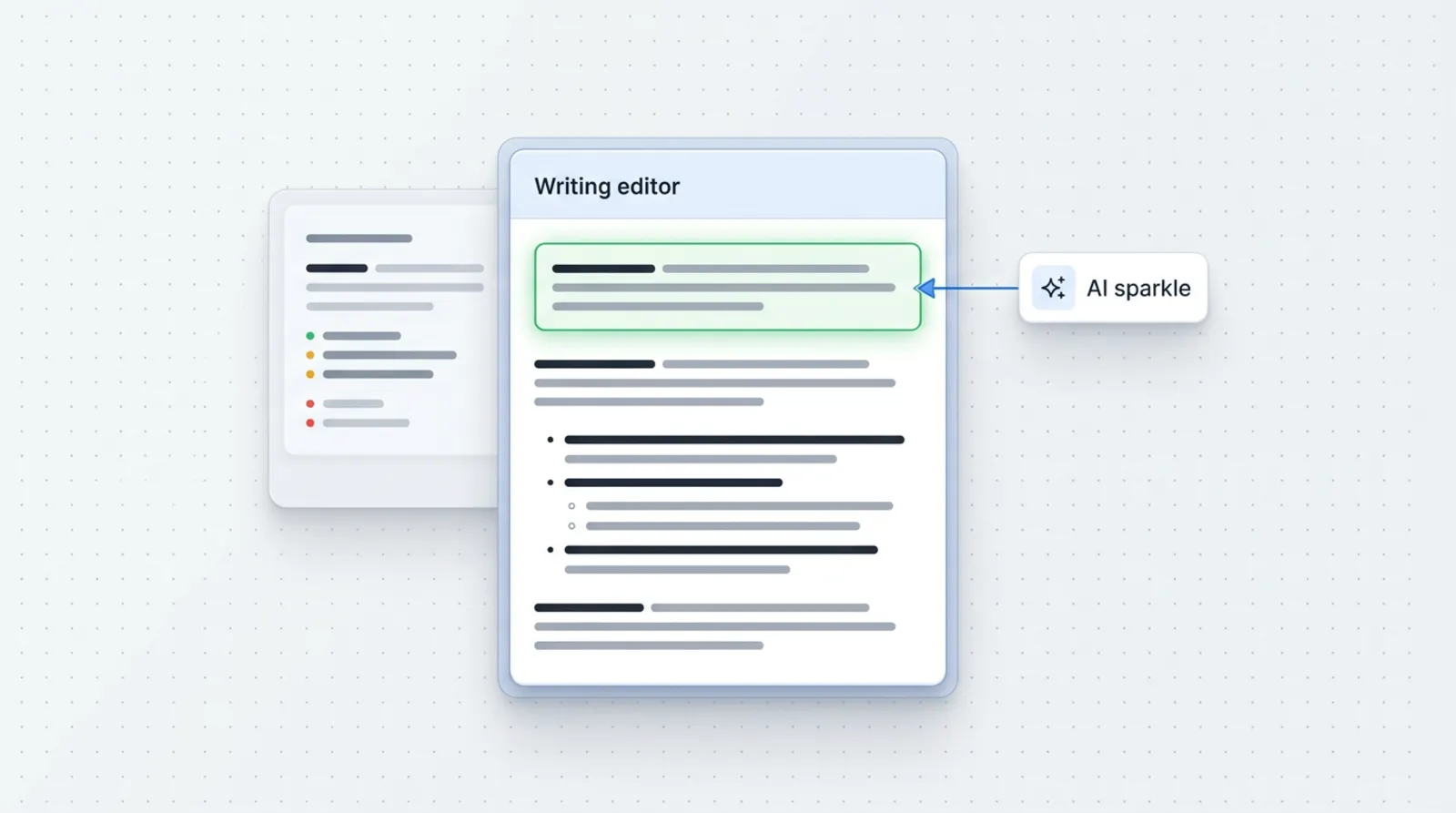
There is one rule: give the answer where the question is asked. The search engine's systems choose fragments that can be taken out of context and still make sense.
- The answer at the start of a section. Under a heading in the form of a question or a topic, write one or two sentences that answer directly. The details come afterwards.
- Concrete definitions. "An AI Overview is..." instead of general introductions. One sentence that can be understood without reading the rest of the page.
- Lists and tables where you compare or list steps. They are readable for a person and easy to extract.
- One section, one issue. Headings should say what the paragraph beneath them is about.
- Currency. For topics that change, such as regulations, procedures or the scope of services, state when the text was checked, and really review it.
A simple example: a provider who, on a page about computer faults, has a section "How long does a laptop repair take?" and under it a sentence on what it depends on (diagnosis, availability of parts, type of fault) is easier to cite than one who writes about a "comprehensive approach to the customer".
From practice: What I see most often are pages on which the answer to the customer's question appears only in the fifth paragraph, after a long introduction about the company. All it takes is moving it to the top of the section for the text to become useful both for the reader and for the search engine.
The phrases around which you build such sections are best taken from real customer questions. I describe how to do it in the post on choosing keywords.
Author, experience and credibility
In its guidelines on helpful content Google describes E-E-A-T: experience, expertise, authoritativeness and trust, with trust being the most important. It is not a single ranking factor but a direction in which content is assessed.
How to show it on an ordinary company website:
- sign texts with a first and last name and write briefly who the author is and what they do every day,
- describe what you know from your work: what the process looks like, what usually goes wrong, what time and cost depend on,
- give the company details and a way to make contact, so that it is clear who stands behind the website,
- if you use AI when writing, you are responsible for the truthfulness of the content and should check it; Google also recommends not creating fictitious authors.
The question Google tells you to ask yourself is: why was this content created. If for the reader, you are on the right side.
Structured data and other signals outside the text
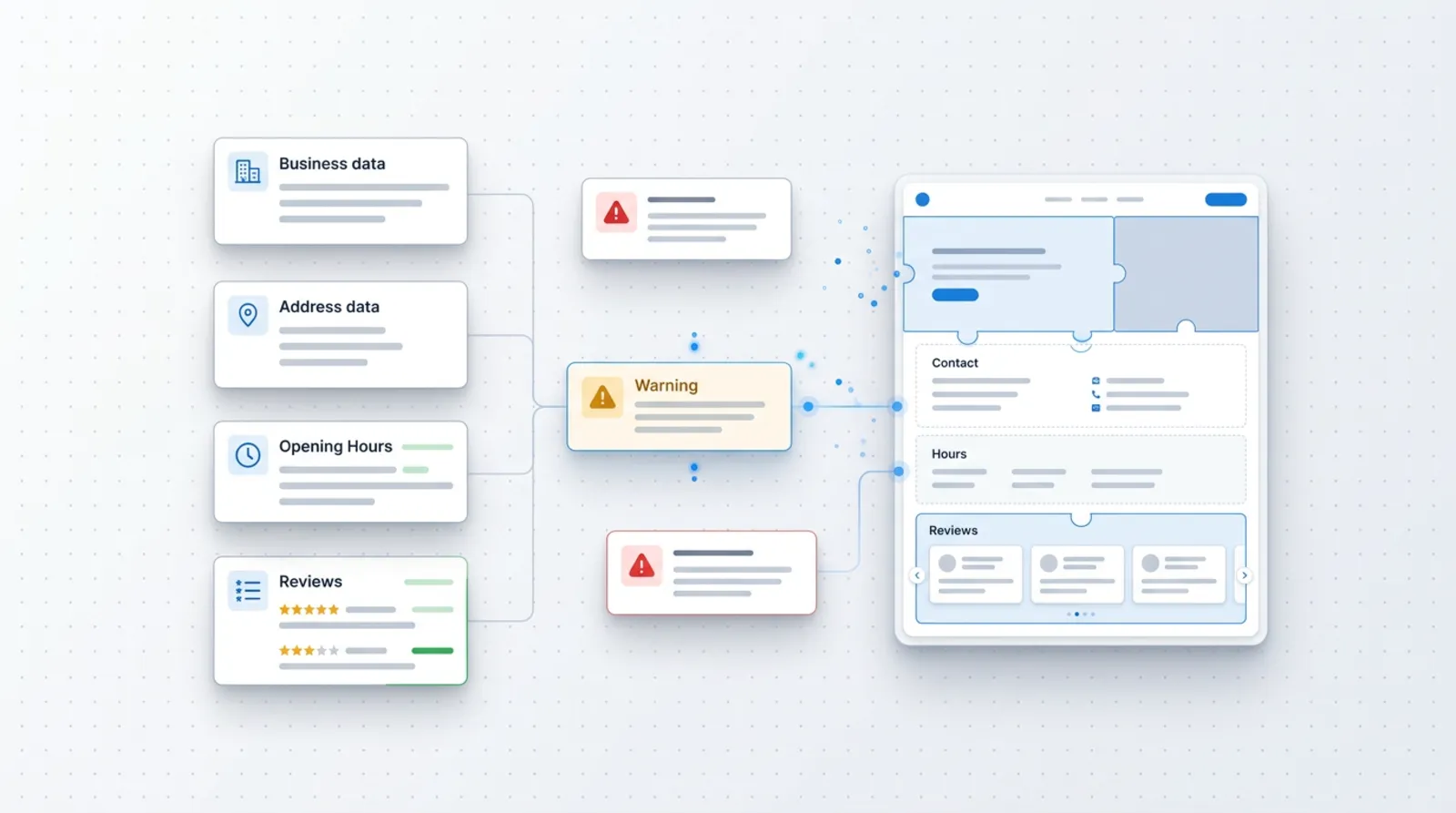
Structured data (Organization, Article, FAQ and similar) is not required to get into AI answers. It does make sense as order, though: it helps the search engine understand what the page is. One rule is firm: the markup must match what is visible on the page. Do not mark up content that the reader does not see.
AI answers also rely on what exists about your business outside your website. With clients I see that it is worth putting in order:
| Area | What to check | Why |
|---|---|---|
| Google listing | Category, hours, services, description | Data about a local business often comes from here. See Google Business Profile for your company |
| Reviews | Whether they are current and whether you reply to them | They show whether the business really operates |
| Company details | The same name, address and phone everywhere | No contradictions builds trust |
| Mentions | Industry directories, partners, local media | They confirm that the business exists and is known |
| Structured data | Consistent with the page content | They organise information but guarantee nothing |
I do not know how much weight each of these signals carries in AI answers, because Google does not disclose it. I treat them as elements of a business's credibility that are needed anyway.
What not to do: mass-produced texts with no value
The temptation is obvious: since AI writes fast, I will generate a hundred pages about every service and every housing estate. That is exactly what Google warns against. In its spam policies it describes "scaled content abuse": creating many pages, including with generative AI, without adding value for users, in order to manipulate results.
Using AI as a writing aid is not forbidden. The problem is mass production and a lack of value. A few safety rules:
- one page should answer a real question, not a variant of a phrase,
- do not publish text that nobody in your company has read and corrected,
- do not invent reviews, data or authors,
- if two pages say the same thing, keep one, the better one.
When you are wondering whether an AI assistant on your website is a good addition, read about the AI assistant on your company website. It is a different tool from text written for a search engine.
From practice: A smaller number of well-described services beats dozens of similar subpages. I usually start with a review of which pages can be merged, not with writing new ones.
How to measure presence in AI answers
According to Google's documentation, traffic from AI features is counted in the overall search traffic in Search Console and reported in the Performance report, under the search type "Web". Do not treat it as a separate, exact indicator of "AI citations". From this data you cannot easily separate visits coming from AI answers from ordinary results, so I look at the trend.
What I check in practice:
- Impressions and clicks for pages where I improved the beginnings of sections.
- Queries in the form of questions that start to appear in the report.
- Whether pages are indexed (the Page indexing report).
- Once a month I type several customer questions into Google myself and note who is cited.
The results of AI answers can differ for different people and on different days, so these are observations, not measurement.
Where to start in your business
Do not rewrite the whole website. Start with a few pages that are meant to bring enquiries.
- Check in Search Console whether the most important service pages are indexed and whether anything blocks them in robots.txt.
- List five questions that customers ask before ordering. For each add a section with the answer in the first sentences.
- Add an author, a review date and contact details.
- Put your Google listing in order and ask customers for reviews. The text on Google reviews will help if you are only starting.
- Check the structured data: whether it matches the content visible on the page.
- Remove or merge repeated, weak subpages.
If you would like me to check whether your website is prepared for search with AI, write to me. I will do a technical and content review and point out what to improve first.
Frequently asked questions
Can I tell Google not to use my website in AI answers?
Partly, yes. In its documentation Google describes controlling snippets with nosnippet, data-nosnippet and max-snippet, among others. They also limit the appearance of ordinary results, though, so consider whether you want that.
Will an llms.txt file help with AI Overviews?
Google writes that you do not need to create special files or markers to appear in AI Overviews and AI Mode. I do not base a strategy on such files.
Can I use AI to write texts for my company website?
You can, but you are responsible for the content. Google warns against mass-generating pages with no value for users. The text should be checked by someone who knows the subject.
How quickly will I see the effects of changes to content?
It depends on how often Google visits the website and how strong the competition is. I do not give timeframes, because nobody can honestly promise them. Watch the trend in Search Console.
Does a local business have a chance of being cited?
Yes, if it has an indexed page with specific answers and a consistent listing and reviews. The size of the business is not a condition in Google's documentation.
Sources

Author
Piotr Babczyński
I help businesses win customers online: SEO, Google and Meta ads, automation and AI. I work from Szczecin, Poland, and remotely. I write about what I test on real projects.
- 30 years in IT
- SEO and Google Ads
- AI implementation
- #SEO
- #AI
- #content