
In short
- The price of SEO depends on competition, the state of the website, content, reach and links, so there is no single price list for everyone.
- The four billing models are a retainer, pay for results, a one-off project and hourly work, and each carries a different risk.
- Google states plainly that nobody can guarantee a first position, so such a promise is a red flag.
- The Search Console and Analytics accounts should belong to you, and the provider gets only access that you can withdraw.
- Compare the scope of work and the way of reporting, not just the amount in two offers.
Table of contents (9)
- How much SEO costs and why there is no single price list
- What the price of SEO depends on
- Billing models: retainer, pay for results, project and hourly
- What an honest offer should contain
- Red flags in SEO offers
- How to compare two SEO offers
- When SEO does not pay off and advertising is better
- Where to start so you do not overpay
- Frequently asked questions
"How much does SEO cost?" is the question I hear most often from business owners, usually before they even ask what exactly they will get. I will not give amounts here, because an honest price depends on your industry, your website and your city. What I will show you is what the cost is made of, what a contract looks like and what to look at when you compare offers.
How much SEO costs and why there is no single price list
In practice, the price of SEO is the price of the work that has to be done on your website and around it. Two companies from the same industry may need a completely different scope, so their bills will differ.
That is why an offer that asks you no questions is suspicious. If the provider does not know your website, your competitors or your goal, they do not yet know how much work is ahead. Such a price is usually a standard package, part of which has nothing to do with your situation.
On the other hand, a good quote is no secret. The provider should be able to explain what they are charging for and put it in writing in the offer.
What the price of SEO depends on

Several factors affect the cost. The more of them work against you, the more work there is and the longer it takes to reach results.
- Competition in your industry and location. A phrase that many strong competitors are fighting for requires more work than a phrase nobody is trying to win.
- The technical state of the website. Slow loading, indexing errors, a missing mobile version or duplicate content have to be fixed before anything starts to grow.
- The amount and quality of content. A website with a single service page needs a different effort than a site that has to be expanded with service descriptions, guides and local pages.
- Reach. Local SEO (city, region) is different work from competing for phrases across the whole of Poland.
- Links from other websites. Earning valuable mentions is labour-intensive. Buying links is not a solution, because Google counts it as a violation of its rules.
- Time to results. The faster you want to see results, the more has to be done at once, and still no reliable provider promises a deadline.
From practice: What changes the most is not the size of the company but what is already on the website. If the basics are done well, the work goes faster and you pay for development, not for repairs.
Before you start comparing quotes, check what stage your website is at. A useful tool is the free Google Search Console panel, which shows which queries your site already appears for and whether Google has any problem reading it.
Billing models: retainer, pay for results, project and hourly
You will most often come across four ways of billing. None of them is bad in itself; each suits a different situation and carries its own risk.
| Model | How it works | Advantages | Risks |
|---|---|---|---|
| Monthly retainer | A fixed fee for continuous work: content, fixes, reports | A predictable budget, work spread over time | You also pay in months without visible changes, so you need a clear plan and reports |
| Pay for results (rankings) | A fee that depends on the position for chosen phrases | Seems fair, because you pay for a result | The provider picks easy phrases that bring no customers; may resort to risky methods |
| One-off project | A set scope for a single fee, e.g. an audit and implementation of fixes | You know the cost in advance, good as a start | When it ends, nobody looks after further development, and results may stall |
| Hourly | You pay for time worked | Flexibility for small tasks and consultations | Hard to predict the total cost, requires trust in the time records |
The "pay for results" model needs separate attention. A position for a phrase is not the same as a customer. A phrase with few searches is easy to push up and gives you nothing. If you are considering this model, agree which phrases, in which location and how the result is measured.
In practice a combination works well: first a one-off audit with a plan, then a retainer for implementation. It is not the only way, but it lets you decide on the basis of specifics rather than promises.
What an honest offer should contain
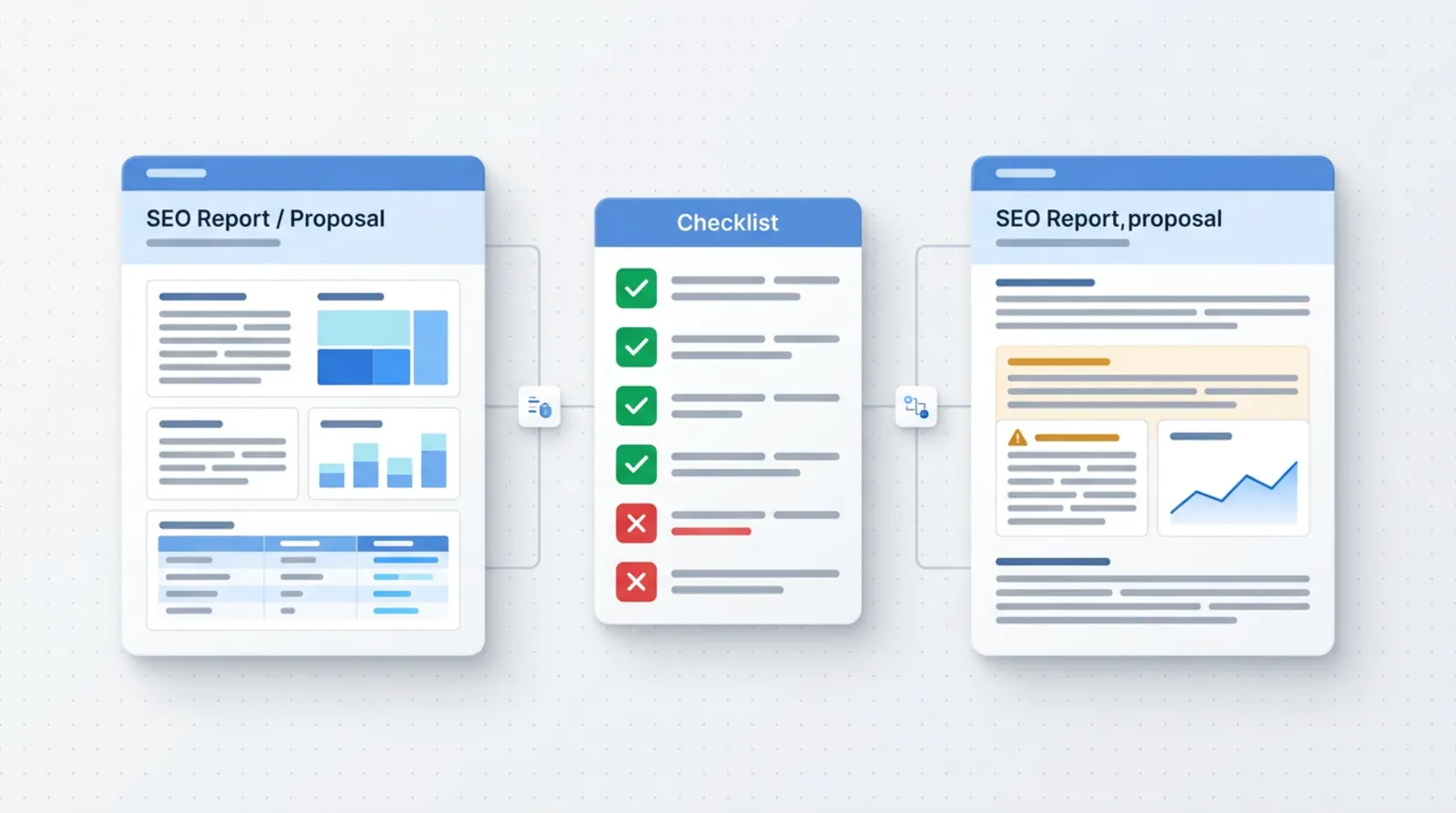
An honest offer says what will be done, when, and how you can check it. If any of the elements below is missing, that is a reason to ask.
- An audit at the start. A description of the state of the website, technical problems and opportunities.
- An action plan. A list of tasks in order, not a vague phrase like "website optimisation".
- Reports. Regular ones, understandable to a non-specialist: what was done, what changed, what next.
- Access to accounts on your side. The Google Search Console and Google Analytics accounts should belong to you. The provider gets access that you can withdraw at any time. Google advises granting read-only access at the audit stage.
- Explaining changes. Google notes that a good specialist should be able to explain everything they change on your website. You are responsible for what the provider does.
- No guarantee of rankings. Google states plainly that nobody can guarantee first place. An honest offer talks about a plan and how progress will be measured, not about a promised result.
You will find the details in Google's documentation on whether you need an SEO expert and how to choose one. Reading it takes a few minutes and gives you a ready list of questions for the conversation.
Red flags in SEO offers
Some signals appear so often that they are worth knowing by heart.
- A guaranteed place in Google. It contradicts what Google itself says.
- Mentions of "special contacts" at Google or a "fast submission".
- No information about what exactly will be done. A provider who hides their methods also hides the risk.
- Buying links or networks of websites. Google treats buying links to improve rankings as a violation of its rules. The consequence may be a drop in visibility of the whole website.
- A Search Console or Analytics account set up in the provider's name. When the cooperation ends, you lose the history of your data.
- A focus on rankings with not a word about traffic and enquiries from customers.
- A contract for many years with no possibility of withdrawing.
From practice: The best test is the question "what exactly will you do in the first month?". A factual answer with a list of tasks says more than the prettiest presentation.
How to compare two SEO offers
Compare the scope and the way of working, not just the amount. Two offers with a similar price can mean a completely different amount of work.
Go through this list for both offers:
| Question | Offer A | Offer B |
|---|---|---|
| Is there an audit and a task plan? | ||
| Which phrases and which location? | ||
| How much content will be prepared? | ||
| What does the work on links look like? | ||
| What reports and how often? | ||
| Who owns the Google accounts? | ||
| How long is the contract and how can it be ended? | ||
| Is there a promise of rankings? |
Fill in the table and the differences will be visible at once. An offer that cannot be filled in because it lacks specifics drops out.
The second step is a conversation. Ask about experience in your industry, the expected time to the first changes and how the provider will assess whether the cooperation is producing results. The answer "it depends" is fine if it is followed by an explanation of what it depends on.
When SEO does not pay off and advertising is better
SEO is work over several months, not a switch. If you need enquiries from customers this week, organic results alone will not deliver them.
SEO can be a poor choice when:
- the business is new or seasonal and has no time to wait for results,
- the website is temporary or is going to be rebuilt,
- nobody in the area types into Google phrases related to your offer,
- the price of the service is so low that a customer would have to buy very often.
In such cases a Google or Meta ad lets you check more quickly whether there is demand. A combination of both routes often makes sense: ads at the start, SEO as a long-term investment. I compare this more broadly in the post Google Ads or SEO at the start.
Where to start so you do not overpay
Start with a diagnosis, not with buying a service. Without it every quote is guesswork.
- Go into Search Console and check whether your website is added there. If not, add it to your own account.
- Write down which queries you want to be found for and in which cities. Two or three services are enough.
- Collect two or three offers and compare them with the table from the previous section.
- Ask about an audit as a separate, first step.
- Decide which numbers will measure success: enquiries, phone calls, forms, not rankings alone.
If you like, I will do a short audit of your website and, on that basis, prepare a free quote. I describe the scope of work on the SEO and search optimisation page, and you can send your question through the contact form.
Frequently asked questions
Can I pay only if the website reaches first place?
Such a model exists, but it has drawbacks. The provider may pick easy phrases that bring no customers, or resort to risky methods. If you are considering it, agree the phrases, the location and the way the result is measured, and preferably measure enquiries from customers, not rankings alone.
How long until SEO results are visible?
It depends on competition, the state of the website and the amount of work to be done, so no reliable provider will give a single deadline. Ask the provider what changes they expect in the first months and how you will recognise them. Google also recommends asking about expected results and timeframes.
Will rankings drop after the contract ends?
They do not have to, but an unmaintained website can lose ground against competitors who keep working. Technical fixes and good content stay on the website. That is why it is worth writing into the contract what passes to you, including access to accounts and materials.
Can I start optimising my website myself?
Yes, part of the work can be done yourself: add your website to Search Console, complete the service descriptions and check the mobile version. A specialist's support is useful for technical diagnosis, a content plan and work on links.
Does buying links speed up SEO?
Google counts buying or selling links to improve rankings as a violation of its rules. You risk a drop in the visibility of the whole website. A safer path is valuable content and natural mentions.
Sources

Author
Piotr Babczyński
I help businesses win customers online: SEO, Google and Meta ads, automation and AI. I work from Szczecin, Poland, and remotely. I write about what I test on real projects.
- 30 years in IT
- SEO and Google Ads
- AI implementation
- #SEO
- #search optimisation
- #quote
- #offer